To learn how to check an answer, start from known information and compare each claim with its source. In this fictional exercise, the calculation is right, but an amount excluding tax becomes an amount including tax and a requested date becomes a confirmed delivery. You will find the documents, the answer to analyse and an explained correction.
How the exercise works
The exercise starts from a case where all the source information is known: a customer request and an internal note. Participants then receive an answer to analyse and must find every gap between this answer and the sources.
Important: the answer shown below is an illustration written for the exercise. It does not report the output of the instruction in a tool or a test of a model. Its errors were chosen because they illustrate gaps you need to be able to spot in generated text, whatever the tool used.
The fictional case
The company, the customer and the order are entirely fictional.
Customer request:
Hello, we would like to order 12 kits at €40 per unit excluding tax, with delivery requested on 18 October. Please confirm the amount and the date.
Internal note:
Kit availability not confirmed. Delivery date not confirmed. Applicable taxes not provided for this order.
Instruction given to the tool:
Write a short, professional reply to this customer request, based only on the request and the attached internal note.
Answer to analyse (written for the exercise):
Hello, thank you for your request. We confirm your order of 12 kits for a total of €480 including tax. Delivery is scheduled for 18 October. Kind regards.
The review: comparing each claim with its source
The method consists of breaking the answer down into claims, then looking for the source sentence that supports each one. When no source supports a claim, it is flagged.
| Claim in the answer | What the sources say | Verdict |
|---|---|---|
| 12 kits | Request: 12 kits | Matches |
| Amount of €480 | Request: 12 × €40 excluding tax, i.e. €480 excluding tax | Correct calculation |
| Amount described as “including tax” | Request: price excluding tax; note: taxes not provided | Error: an amount excluding tax presented as including tax |
| “We confirm your order” | Note: availability not confirmed | Commitment with no source |
| “Delivery is scheduled for 18 October” | Request: requested date; note: date not confirmed | Error: a wish turned into a promise |
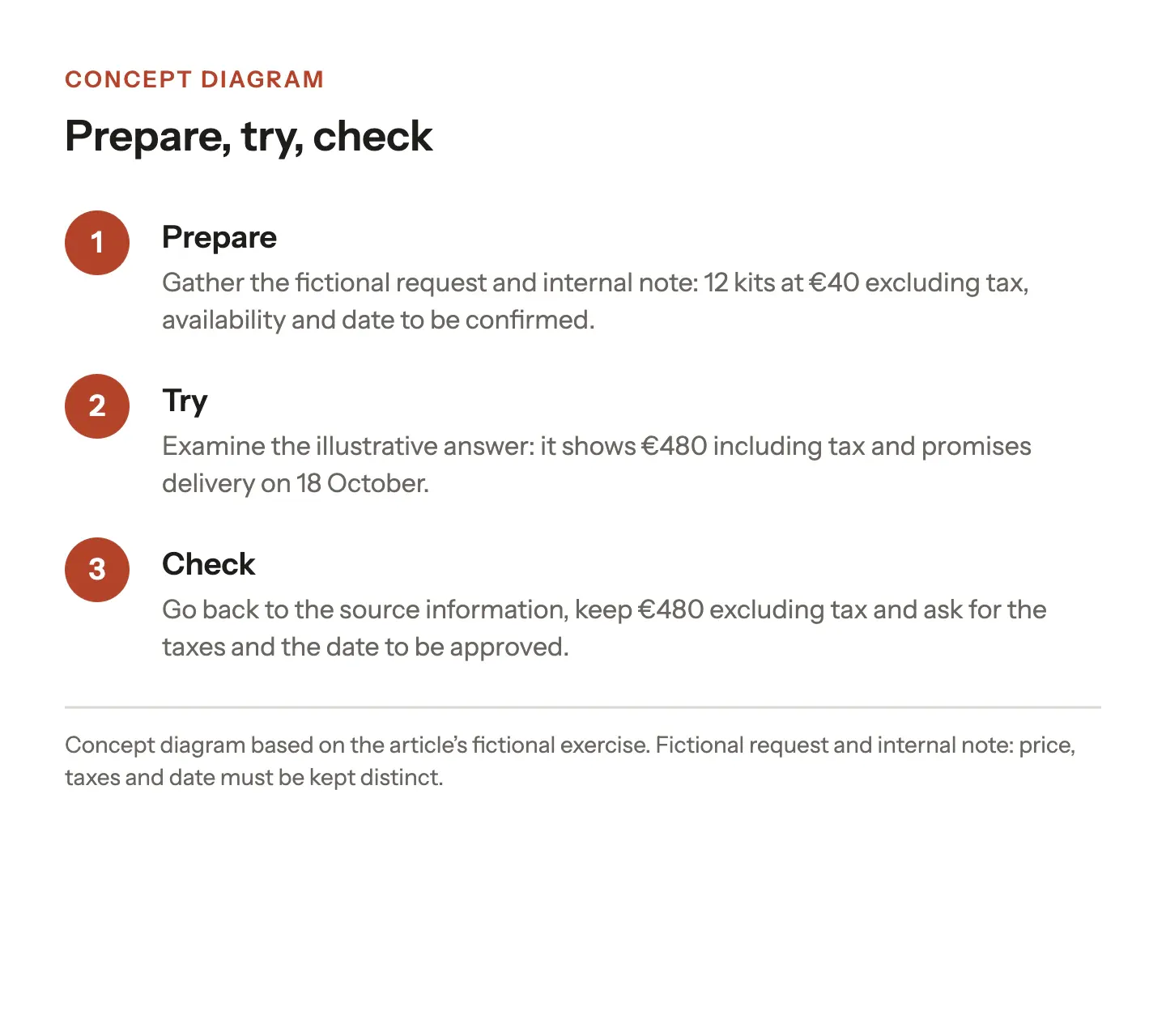
The exercise path: prepare the documents, examine the illustrative answer and check each claim. The table above details the gaps in the fictional case.
The trap in this exercise lies in a correct calculation. The figure 480 is right, which gives an impression of reliability. The error is in the label that goes with it. A hurried reader can check the calculation, find it correct and fail to notice that the amount has changed its nature. Likewise, “is scheduled” and “we confirm” are common phrases in a sales reply: they slip through easily, yet they create a commitment that nobody in the company has made.
The corrected answer
Hello, thank you for your request. For 12 kits at €40 per unit excluding tax, the total comes to €480 excluding tax. We will send you the amount including tax as soon as the applicable taxes have been confirmed. We have noted that you would like delivery on 18 October. We are checking the availability of the kits and the possible delivery date, and will come back to you to confirm. Kind regards.
The correction keeps the established facts. The amount stays excluding tax, as in the source. No tax rate is invented to calculate an amount including tax: the information is missing, and the answer says so. The date of 18 October is presented as the customer’s request, not as a commitment. A person reviews this draft before it is sent. Any delivery promise then requires internal confirmation of availability and the date.
A reusable checklist
This list can be used for any answer intended for a customer, whether written with or without AI:
- Break down the answer into claims: figures, dates, quantities, names, commitments.
- Find the source of each claim in the documents provided. A claim with no source is flagged.
- Check the qualifiers: excluding or including tax, currency, unit, total or unit quantity.
- Redo the calculations, even when they seem obvious.
- Distinguish between a wish, an assumption and a confirmation. A requested date is not a confirmed date.
- Spot implicit commitments: “we confirm”, “is scheduled”, “no problem”.
- Leave missing what is missing: no rate, lead time or price filled in by guesswork.
- Name the person who approves before sending.
- Review the data given to the tool before entering it.
On this last point, the CNIL, the French data protection authority, points out in its resources for small businesses that content produced by generative AI may be inaccurate and must be checked. It also recommends limiting the personal and confidential data entered into these tools. What a provider does with the data it receives, including for training its models, depends on the provider, the product, its configuration and the contract. This is checked before use, not afterwards.
Running the exercise with a team
Here is one possible format:
- Hand out the customer request and the internal note, without the answer.
- Ask everyone to note what a good answer can state, and what it cannot.
- Hand out the answer to analyse and have each person fill in the claim, source, verdict table individually.
- Compare the tables as a group and discuss the gaps that were missed, especially those that look correct at first reading.
- Write the corrected answer together.
- Transpose the exercise to a document from the team’s own work, using fictional or anonymised data.
The last step is the most useful. It makes the team identify its own pitfalls: a warranty period, a discount, a product reference, a contract clause.
The limits of this exercise
This fictional case shows a checking method. It is not a comparative evaluation of AI tools, it does not measure the reliability of any model and it provides no guarantee of security or compliance. A team that succeeds in this exercise has learned to read an answer methodically; it still has to apply this method to its own documents, with its own approval rules.
Building a checking method into your team
The exercise gives you a starting point: finding the information, spotting a commitment with no source and correcting the answer before it is sent. To apply it at work, your team also needs to know which documents it may use, which gaps to check and who to pass a doubt on to.
In my AI training, I prepare the exercises from the tasks we define together, with authorised examples adapted to the participants’ level. We work on writing requests, checking answers and the limits on using data. You receive the exercises and a practical sheet so you can apply the method again after the session.
The value is in having shared reference points for reviewing a text or preparing a customer reply, and in knowing when to ask for a check. I run workshops for teams and one-to-one sessions. Tell me about the tasks concerned, the tools available and the people to be trained so that we can define the content and the quote.