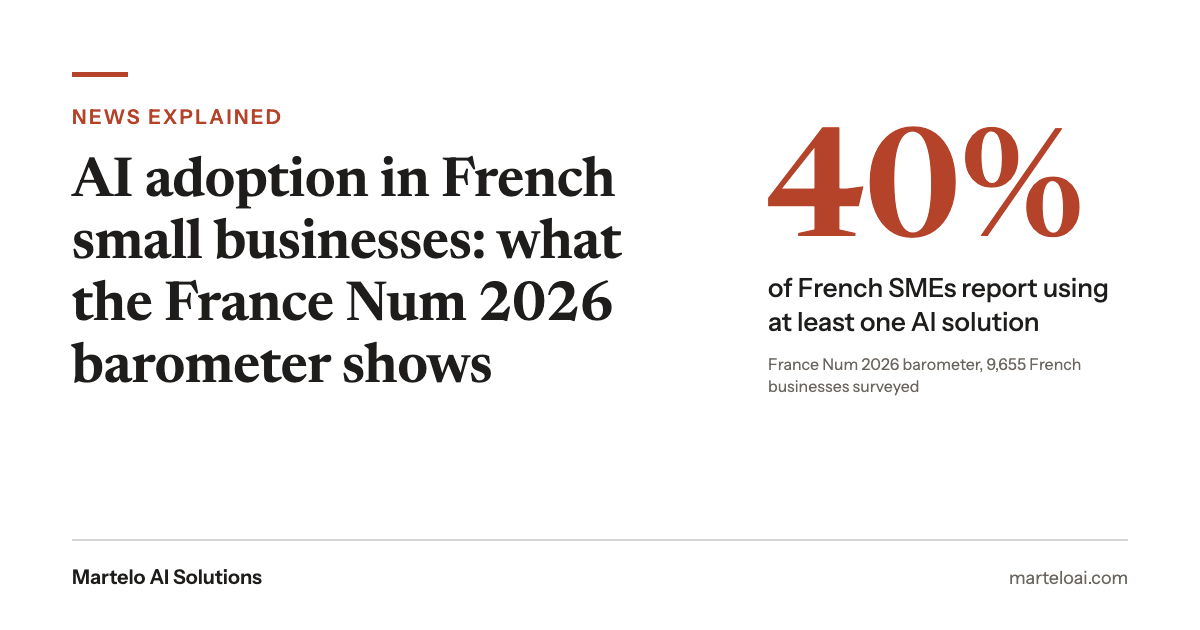
The presentation page of the France Num 2026 barometer, published on 17 September 2026 and updated on 28 September, provides recent figures on how French small and medium-sized businesses use artificial intelligence. France Num is the French government’s programme for the digital transition of small businesses, and its barometer surveys businesses in France. These figures show a trend. They do not, however, tell you where your own business should start. This article briefly summarises the published results, then offers a practical reading and a worksheet to fill in for a specific task.
The barometer’s main figures
The survey covers 9,655 businesses in France, including 6,786 very small businesses (TPE) and 2,869 small and medium-sized businesses (PME), surveyed between 23 March and 18 April 2026. According to France Num, 40% of these French TPE and PME report using at least one AI tool, an increase of 14 percentage points. Among the businesses that use AI, 68% perceive a positive impact.
The barometer also breaks down the types of use, expressed as a share of all French TPE and PME:
| Type of AI use | Share of all French TPE and PME |
|---|---|
| Content generation | 34% |
| AI assistants | 24% |
| Document analysis and classification | 13% |
| Task automation | 11% |
| Data analysis and prediction | 9% |
Source: France Num, France Num 2026 barometer, presentation page and official infographic (PDF), consulted on 1 October 2026. Data published under the Etalab Open Licence 2.0. Population: businesses in France.
The same business can report several uses. The percentages overlap: they do not add up and do not form a total of 100%.
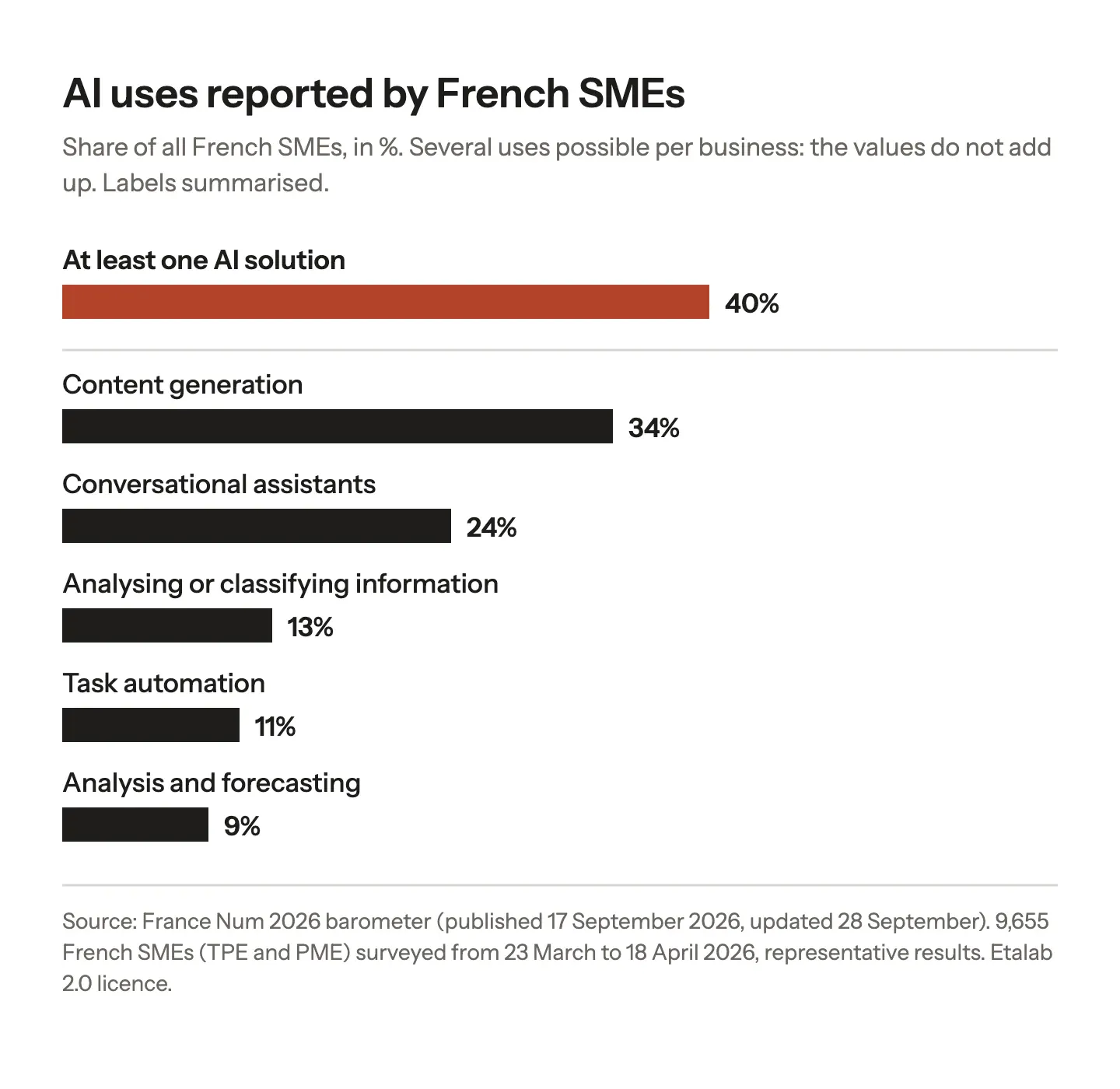
Same data as the table above. Each bar is independent: a business can appear in several categories. Source: France Num 2026 barometer, French businesses.
What these figures measure, and what they don’t
I would keep three distinctions in mind before applying these figures to your business.
Reported use is not a measured gain. The 40% corresponds to businesses that report using at least one AI tool. This figure says nothing about how often the tool is used, how many employees use it or how much time is actually saved. A business that opens an assistant once a month and another that has built it into a daily process can give the same answer.
The denominators are not the same. The 40% and the percentages in the table are calculated on all TPE and PME surveyed. The 68% only covers businesses that already use AI. Putting these two series side by side without saying so mixes two populations. The 68% therefore does not mean that 68% of small businesses see a positive effect.
A perception is not a result. Perceiving a positive impact is interesting information, but it is not a quantified return on investment. A feeling says nothing about the time saved, the errors avoided or the cost of the tools in each business surveyed.
These limits take nothing away from the barometer’s value. They simply remind us that it describes reported answers at national level in France, not how effective a given use is in a given business.
The barometer cannot choose your first project
These proportions describe a national trend in France. The fact that content generation comes first does not mean that it is the right starting point for you. A service business that processes dozens of receipts every month does not have the same priorities as a shop that publishes product pages every week.
Choosing a first trial depends on questions that only your context can answer: which task comes up often, what data is available, who can check the result, and what happens when a case falls outside the norm. Nor does the barometer recommend any tool. Choosing a tool before describing the task can lead you to look for a use for it, before you have defined what you want to achieve.
A worksheet for an administrative task
The worksheet below is filled in for an entirely fictional example: a six-person consulting firm that prepares, every month, the summary of expense claims for its accountant. It is meant as a template. Replace each line with your own task.
| Heading | Fictional example: monthly summary of expense claims |
|---|---|
| Specific task | At the end of the month, prepare the table of expenses to send to the accounting firm |
| Input | Receipts received by email (photos and PDFs), list of current projects |
| Expected output | A table with date, supplier, amount, category, project and a link to the receipt |
| Person who checks | The office manager, before anything is sent to the accounting firm |
| Known exceptions | Illegible receipt, expense in a foreign currency, duplicate, expense with no associated project |
| Rule for exceptions | Line marked “to review”, no value filled in by guesswork |
| Small trial | Twenty receipts from a month that has already been closed and processed by hand, compared line by line |
A few remarks about this worksheet.
The task is described by its result, not by a technology. “Using AI for admin” is not a task. “Producing the monthly expense claims table” is one.
The person who checks is named. If nobody has the time or the authority to check the output, the trial makes no sense, whatever tool is chosen.
The exceptions are listed before starting. They show where a tool is likely to make mistakes and where a simple rule should send the case back to a person.
The trial uses data that has already been processed. Comparing the result with existing manual work lets you count the differences: correct lines, lines to correct, exceptions properly flagged or missed. I deliberately set no time-saving target before the trial. The first criterion is reliability; time is measured afterwards, on your own data, if the result is usable.
Finally, receipts often contain personal or confidential data. What the provider does with the data entered, including for training its models, depends on the provider, the product chosen, its configuration and the contract. Check these points before sending real documents.
From the figures to a decision for your business
For your business, the next step is to choose a task and check what a first trial requires: accessible information, an expected result and a person to check it. The worksheet in this article is a way to start that thinking.
If you have several tasks in mind or tools that overlap, I can help you make that choice through an AI assessment. We examine how you work today, your data and your constraints. I compare the possible options and give you a written assessment, with priorities and the conditions to put in place for a first trial.
You then have a basis for deciding where to invest your time and budget, which questions to resolve and what can wait. The assessment is a service quoted individually, independent of any implementation: you can use its conclusions to decide what comes next. The free 15-minute first conversation is used to understand your need and see whether this work would be useful.